Posts tagged PPAP
24 articles

How to Run a Gauge R&R Study (and Why a Passing %GRR Can Still Fail the Part)
A Gauge R&R study can clear the 10% line and still be worthless, because the number is being read against the wrong denominator. A worked study, run through QualityEngineer.ai's own Analyze module, showing what %GRR against tolerance hides, why NDC catches it, and how Element 8 coverage finds the gauge nobody studied at all.

PPAP Rejection Reasons: Why Packages Bounce and How Each One Gets Caught Before Submission
Most PPAP rejections are not a missing document, they are two elements that are supposed to say the same thing about the same characteristic and do not. Five recurring rejection categories from the reviewer's seat, the AIAG PPAP element and IATF 16949 clause behind each, and how QualityEngineer.ai's linked traceability graph surfaces the gap before a reviewer does.

PPAP Readiness Score: Why 'Complete' and 'Ready to Submit' Are Two Different Numbers
A PPAP package can show every element checked off and still bounce on the first read. Here is how QualityEngineer.ai splits readiness into two numbers that are never averaged together, an element completion headline and a structure quality score built from AIAG capability and traceability rules, plus the proactive findings that catch a gap before a reviewer does.

AI GD&T Extraction: How a Drawing Becomes a PPAP-Ready Characteristic List
A new revision lands and someone has to read every GD&T feature control frame, balloon it, and type it into a spreadsheet before the PFMEA or Control Plan can start. Here is how Blueprint Intelligence turns that drawing into structured characteristics instead.

PPAP Element 8: What Has to Be Covered Besides the Gauge R&R Report?
A single Gauge R&R report attached to Element 8 flips the element's status to submitted, but that is not the same as every special characteristic on the part having a defensible measurement system behind it. Here is what Element 8 actually has to cover under AIAG PPAP 4th Edition and IATF 16949 Clause 7.1.5.1.1, why a package can look complete and still leave a critical gauge unqualified, and how QualityEngineer.ai tracks MSA coverage characteristic by characteristic instead of element by element.

PPAP Element 10: What Actually Counts as a Material and Performance Test Result?
A mill cert PDF is not Element 10. Records of Material and Performance Test Results is its own PPAP element with its own heat lot traceability, DVP&R coverage, and lab accreditation requirements under AIAG PPAP 4th Edition and IATF 16949 Clause 8.6.2. Here is what has to be in the folder, why the cert alone gets kicked back, and how QualityEngineer.ai keeps the material record attached to the part instead of floating in an email thread.

Part Submission Warrant: How Do You Fill Out a PSW That Matches What Is Actually in the Package?
Most PPAP rejections on the warrant are not manufacturing problems. A box is checked for an element that is not in the folder, or the revision on the cover does not match the design record behind it. Here is how QualityEngineer.ai generates the Part Submission Warrant from the package itself, so PPAP Element 18 cannot claim something the submission does not contain.

AS9102 Form 3 Dimensional Results: How Do You Catch an Out-of-Tolerance Characteristic Before the FAI Ships?
The FAI that gets rejected two weeks after you ship it usually fails on one out-of-tolerance result nobody flagged. Here is how QualityEngineer.ai records AS9102 Form 3 dimensional results against the ballooned drawing so every measured value is checked against its own tolerance the moment it is entered, not by the customer's source inspector.
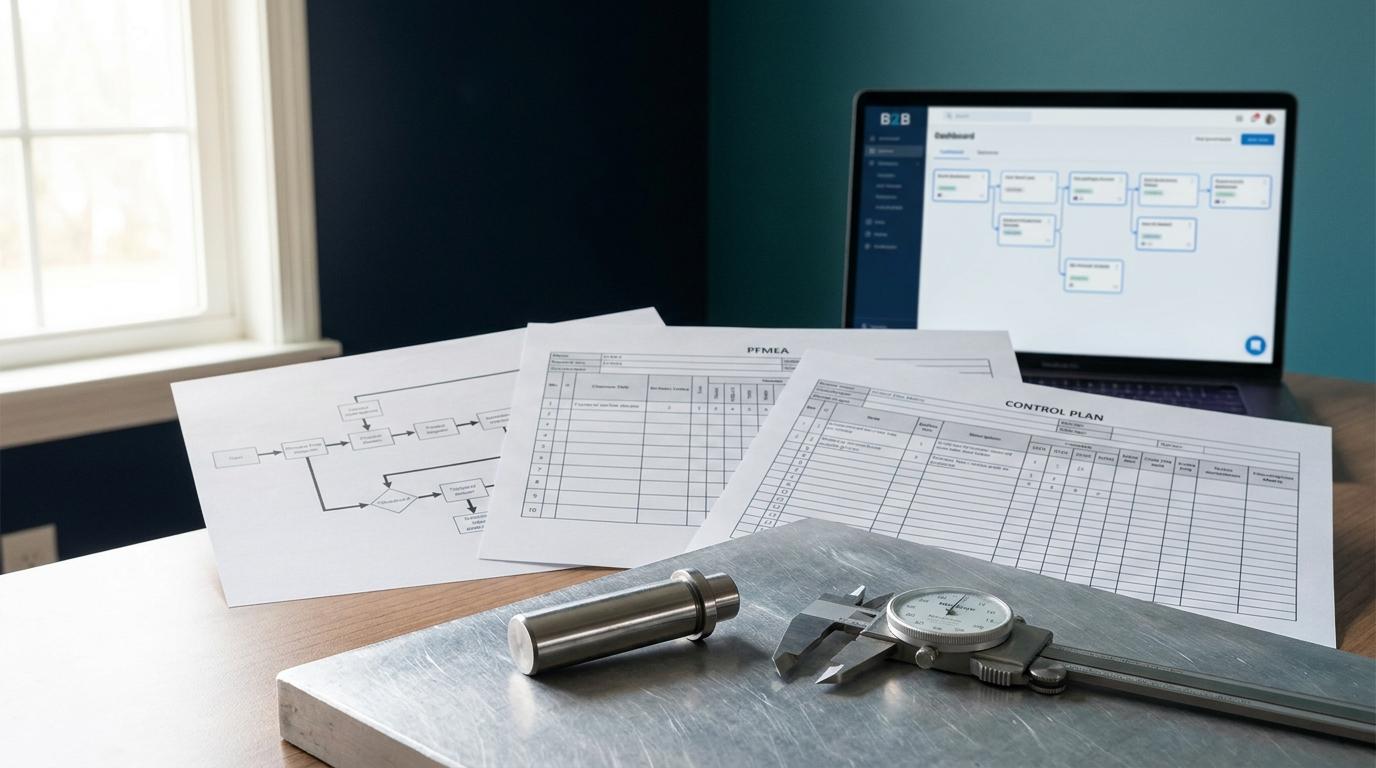
PFMEA to Control Plan Linkage: How We Build One Document From the Other
The PPAP kickback that says your Control Plan does not match your PFMEA comes from re-keying three documents by hand. Here is how QualityEngineer.ai links Process Flow, PFMEA, and Control Plan so the alignment holds by construction, not by proofreading.

The Year the Rulebook Gets Rewritten
ISO 9001, IATF 16949, and AS9100 are all being revised at once, a rare forced recall put traceability back in the spotlight, and AI inspection moved to the line. What a quality engineer should actually do about it.
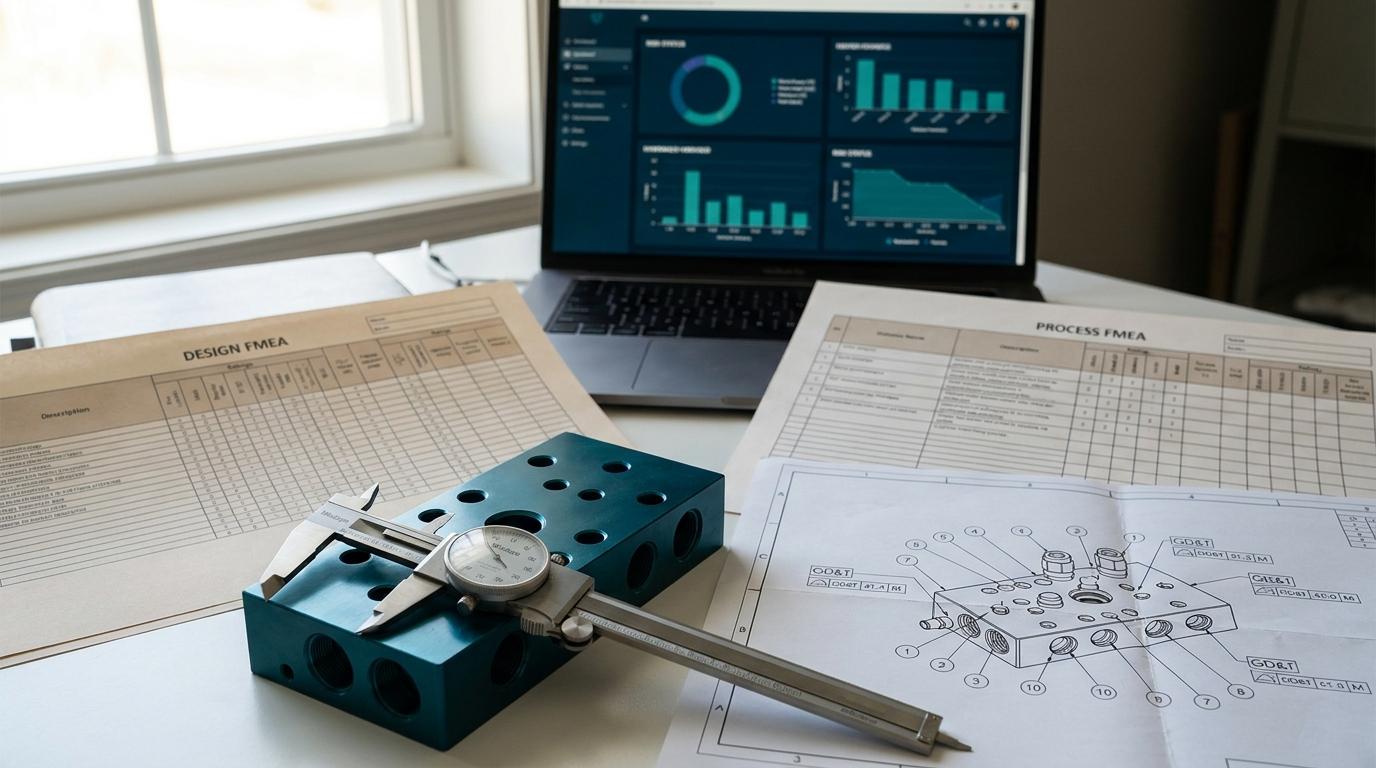
DFMEA vs PFMEA: How Design and Process FMEA Divide the Work and Where They Have to Line Up
A DFMEA and a PFMEA are not the same document at two stages of maturity. They analyze different things, are owned by different people, and get kicked back for different reasons. Here is what each one covers, how the AIAG-VDA seven-step method applies to both, and the severity and characteristic links a customer reviewer checks first.
PPAP Submission Levels 1 Through 5: What Each Level Requires and How Your Customer Decides Which One You Submit
A practitioner walkthrough of the five PPAP submission levels in the AIAG PPAP 4th Edition. What Level 1 through Level 5 each require you to submit versus retain, why Level 3 is the default, how the customer designates the level, what a significant production run has to look like, and how to read the Submission and Retention Requirements table so your package matches what the SQE actually asked for.
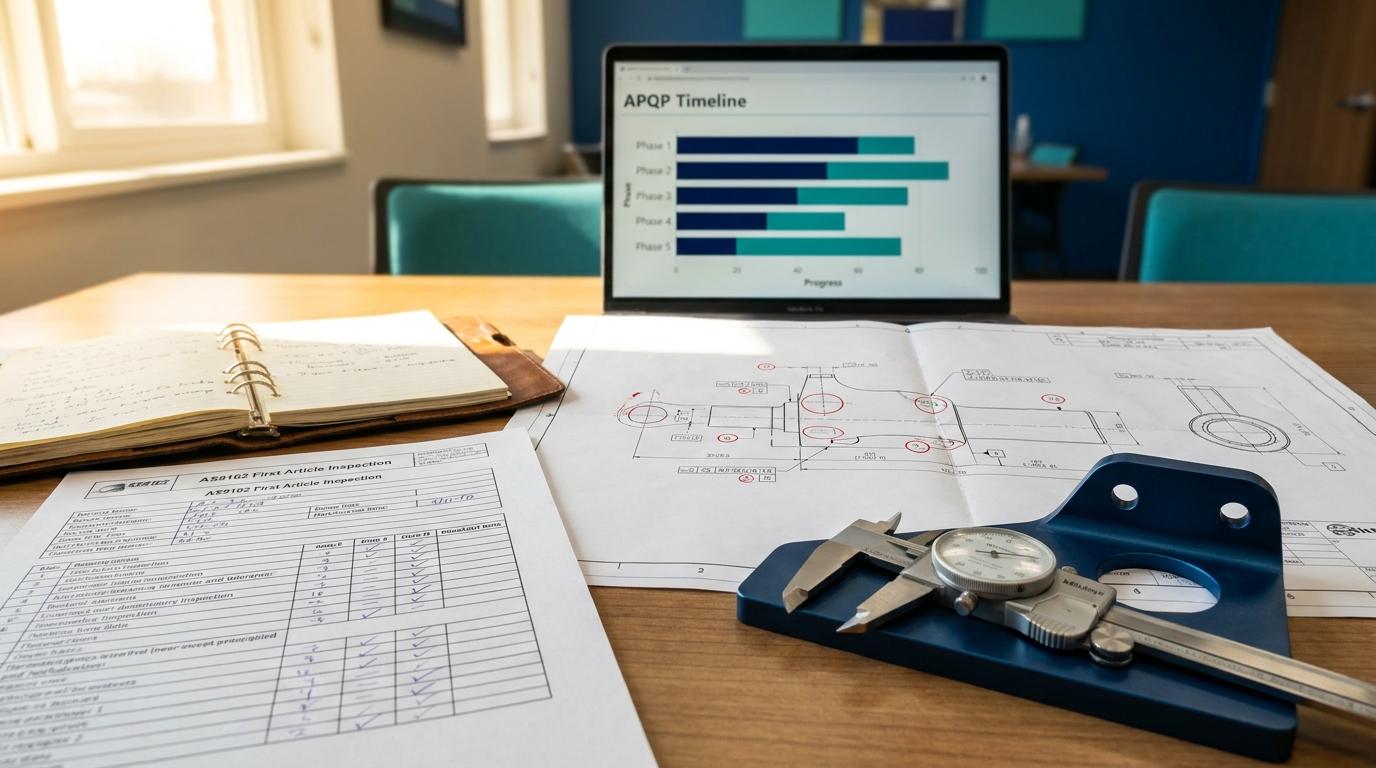
AS9145 Aerospace APQP and PPAP: A Field Map for Suppliers Coming From AIAG
An aerospace customer just flowed down AS9145 instead of AIAG APQP and PPAP. Here is a practical mapping of the five phases, the 11 aerospace PPAP elements versus the automotive 18, where AS9145 diverges from what you already do, and the traps that get a first submission kicked back.

PPAP Element 11 Initial Process Studies: What Ppk Value Passes and Why Reviewers Reject the Number Before They Read It
Element 11 is where the statistical work of a PPAP package either holds up or collapses. A reviewer's-seat walkthrough of Initial Process Studies under AIAG PPAP 4th Edition: why initial studies report Ppk and not Cpk, the three-tier acceptance criteria at 1.33 and 1.67, the two prerequisites a reviewer verifies before trusting your index, the significant production run sample rules, the non-normal and one-sided characteristic trap that voids a clean-looking number, five kickback patterns, and a pre-submission QA pass you can run in fifteen minutes.

Supplier Quality Trends 2026: What Is Actually Changing on the Floor This Year
A practitioner read on what is shifting in supplier quality in 2026. Not the analyst slides. The clause changes, the customer scorecard moves, the NADCAP scope tightening, the PPAP and APQP 3rd Edition transition, the engineering drawing intelligence buildout, and the data exchange standards that are starting to land on supplier dashboards. What each one means for a supplier quality engineer who has to ship FAIs and PPAPs through it.

APQP 3rd Edition Transition: What Changed in the Combined APQP and Control Plan Manual and What Your Submission Package Has to Look Like Now
A practitioner walkthrough of the AIAG APQP and Control Plan 3rd Edition. What changed from the 2nd Edition APQP manual and the separate Control Plan reference, how the combined manual restructures the five phases, what cybersecurity and product safety expectations got added, and how to rebuild your APQP package so PPAP reviewers find what they look for in the new order.

PPAP 18 Elements Checklist: What Each Element Has to Show to Pass a Customer Submission Review
A practitioner checklist for all 18 PPAP elements under the AIAG PPAP 4th Edition. What each element actually has to contain, the reviewer mindset on the customer side, and the specific defects that get a Level 3 package kicked back to Interim.

FAI vs PPAP: When Aerospace Suppliers Need First Article Inspection, PPAP, or Both
FAI under AS9102 and PPAP under AIAG cover similar ground for different supply chains. A practical guide to where they overlap, where they don't, which customers ask for which, and how dual-cert aerospace shops keep one source of truth feeding both submissions.

PPAP Software: How Purpose-Built Tools Reduce Submission Rework
PPAP submissions get kicked back for the same handful of reasons: missing elements, inconsistent revisions, mismatched characteristics. PPAP software solves the rework problem by enforcing structure across the 18 elements before the package leaves your hands.

Gauge R&R Acceptance Criteria: %GRR, NDC, and What AIAG MSA Requires
A Gauge R&R study passes when %GRR is under 10% and NDC is at least 5. Between 10% and 30% is conditional. This guide covers the AIAG MSA thresholds, what %GRR and NDC mean, which values trigger rejection, and what to do when a measurement system does not pass.

Control Plan in Manufacturing: What Goes in It and How to Build One
A column-by-column breakdown of the manufacturing control plan: what each field requires, how it connects to your PFMEA, and what auditors actually check under IATF 16949 Clause 8.5.1.

Cpk vs Ppk: Which Process Capability Index to Use for PPAP
Cpk and Ppk measure process capability differently and are not interchangeable on a PPAP submission. Here is what each one measures, which sigma each uses, and what PPAP Element 11 actually requires.

Process FMEA (PFMEA): A Practical Guide for Automotive Quality Engineers
How to build a Process FMEA that holds up under customer review and IATF 16949 audit scrutiny, including the AIAG-VDA 2019 shift from RPN to Action Priority.

What is PPAP? A Complete Guide for Quality Engineers
Everything quality engineers need to know about PPAP, definition, the 18 elements, submission levels, common mistakes, and how AI is changing the process.