Audits and Compliance
Audits are where the gap between what your QMS says and what your team actually does becomes painfully visible. Whether the auditor is IATF, AS9100, ISO 9001, VDA 6.3, or a customer second party team, the rituals look similar, the findings look similar, and the prep work is rarely as ready as anyone claims. The guides in this topic cover the practical checklists, the clauses most commonly missed, and how to keep an audit ready posture without dedicating a person full time to staring at the document control system. Written for engineers who would rather pass an audit than perform one.
15 articles in this topic
Featured article
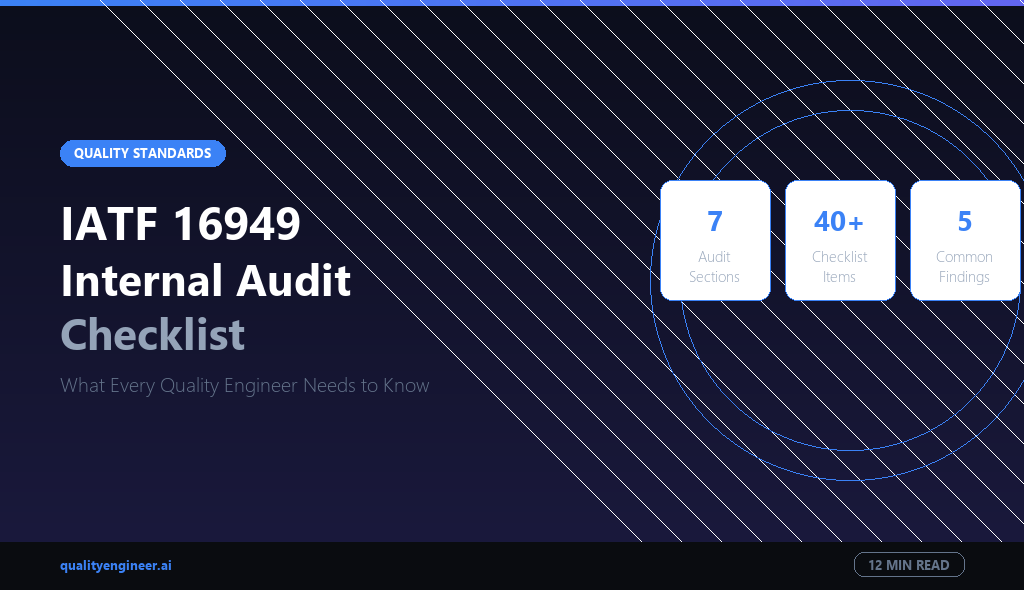
IATF 16949 Internal Audit Checklist: What Every Quality Engineer Needs to Know
A practical IATF 16949 internal audit checklist covering all major clauses, common findings, and tips for running audits that actually prepare you for certification.
Read the full guideIATF 16949
Automotive QMS clauses, common findings, and prep that actually works.

VDA 6.3 vs IATF 16949: Which Audit You Are Actually Scheduling, and How We Keep Them Apart
VDA 6.3 and IATF 16949 both get called 'the automotive audit,' but one audits a process and rates it A, B, or C, and the other audits a management system against numbered clauses. Where each one sits in your audit calendar, what clause 8.4.2.4.1 says decides which second-party audit a supplier gets, and how QualityEngineer.ai schedules, plans, and tracks a VDA audit without pretending to be the VDA question catalog.

IATF 16949 Clause-by-Clause Audit Readiness: What the Automotive-Specific Requirements Actually Ask For
A clause-by-clause walk through IATF 16949's automotive-specific adders, the decimal sub-clauses layered on top of ISO 9001 that trip up surveillance audits. What objective evidence each one wants, why a single internal audit program is not enough under clause 9.2.2.1, and how the platform keeps the QMS, layered process, and supplier audit trails separate instead of collapsing them into one generic checklist.
AS9100
Aerospace QMS specifics where AS9100 diverges from automotive practice.

First Article Inspection Report Rejected: Where the AS9102 Chain Actually Breaks
An AS9102 binder rarely comes back for a missing document. It comes back because one link broke in the chain from drawing to balloon to characteristic to Form 3 result to Form 1 signature. Six recurring chain breaks, in practitioners' own words, mapped to what Rev C requires, what a source inspector checks, and what QualityEngineer.ai does, and does not yet do, about each one.

AS9102 Form 1 Part Number Accountability: The Cover Sheet That Locks the FAI Binder and How Rev C Rewrote It
Form 1 is the smallest sheet in an AS9102 FAI package and the one that determines whether the reviewer even opens Form 2. A field by field walkthrough of Form 1 under AS9102 Rev C: the Part Type shift that replaced the serial number, the signature lock that closes the binder, the sub-assembly rollup rules, the full versus partial declaration, the four kickback patterns that eat submissions, and a pre-submission QA pass a supplier quality lead can run in twenty minutes.

AS9102 Form 2 Product Accountability: The Materials, Special Processes, and Functional Testing Evidence That Has to Survive a Customer Reviewer
AS9102 Form 2 is the FAI form most often returned by a customer reviewer, and not because of the part. It is the supply chain map: every material spec, every special process, every functional test, with the supplier and the cert that proves it. A practitioner walkthrough of what each cell has to carry, the four kickback patterns that cost the most rework, and how to QA the form before the binder leaves your hands.
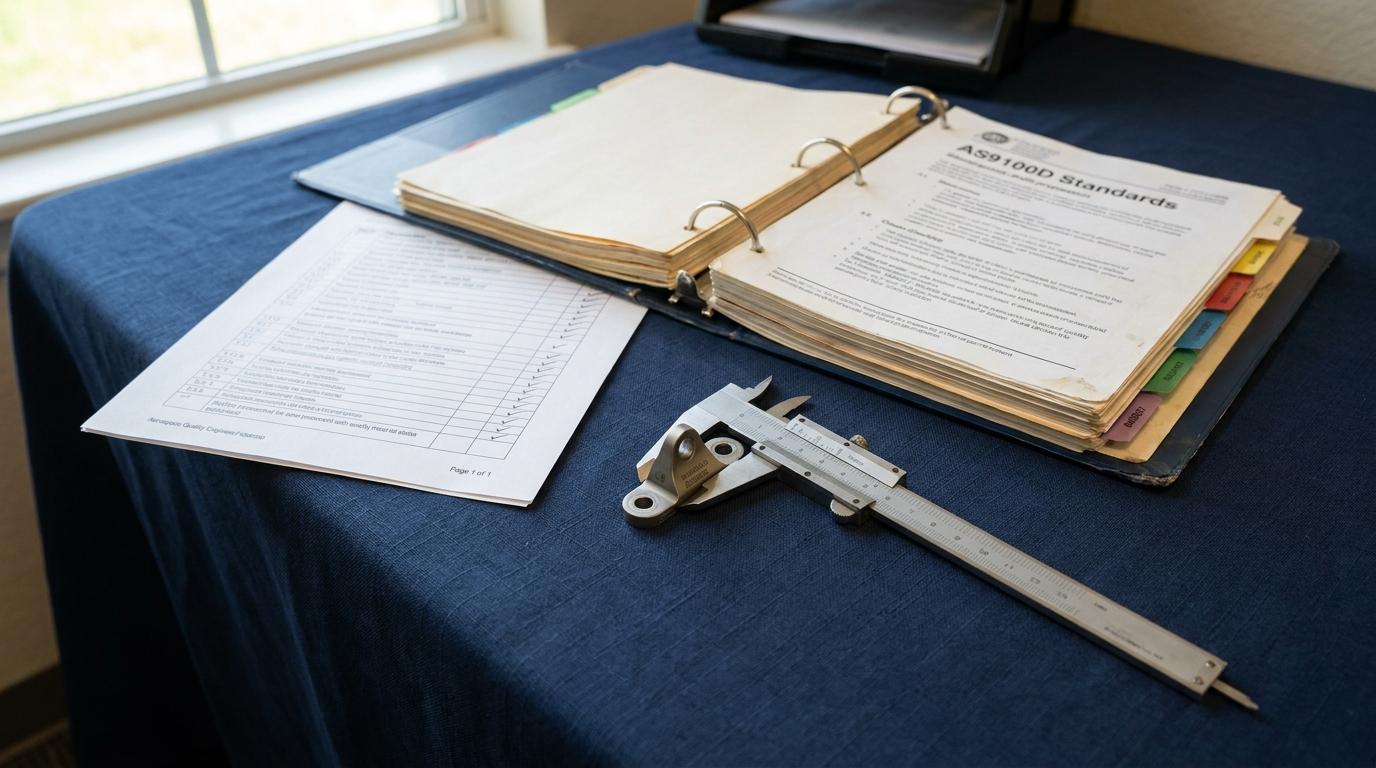
AS9100 Clause-by-Clause Audit Readiness: What Objective Evidence Each Requirement Wants Before the CB Walks In
An AS9100D readiness walkthrough by clause. What objective evidence each requirement expects, how the certification body actually verifies it, and the specific gaps that turn into minor and major findings during Stage 2 and surveillance audits.

AS9102 Partial FAI Re-accomplishment: When You Need One and What Has to Be in the Binder
AS9102 partial FAI re-accomplishment is the clause aerospace SQEs argue about most. A practical guide to Clause 4 triggers, the impact analysis a customer expects to see, what changes on Form 1, Form 2, and Form 3 when scope is partial, and how to keep the original FAI binder defensible through a revision.

Characteristic Accountability in AS9102: How to Balloon a Drawing So Form 3 Maps One to One
Characteristic accountability is where most AS9102 FAI packages get rejected. A practical guide to ballooning a drawing under Rev C, what counts as a characteristic, how GD&T and notes get numbered, and how to make Form 3 map one to one to the design record.

Counterfeit Parts Prevention: How AS5553, AS9100 Clause 8.1.4, and DFARS Fit Together
A practical guide to counterfeit parts prevention for aerospace and defense suppliers. How AS5553, AS9100D Clause 8.1.4, and DFARS 252.246-7007 connect, what a counterfeit avoidance system actually requires, the authorized distributor rule, GIDEP reporting, and AS6171 test methods.

AS9102 First Article Inspection: How Form 1, Form 2, and Form 3 Fit Together Under Rev C
A practical guide to the AS9102 First Article Inspection report under Rev C. Form 1 part accountability, Form 2 material and process verification, Form 3 dimensional results, when an FAI is required, how to handle re-accomplishment, and what changed from Rev B.

AS9100 Internal Audit Checklist: What Aerospace Quality Teams Need to Cover
A practical AS9100D internal audit checklist for aerospace quality engineers. Covers all clauses, the aerospace-specific adders to ISO 9001, common Rev D findings, and how AS9100 differs from AS9102 and NADCAP.
More in this topic
Latest articles, sorted by date.

ISO 9001:2026: What's Actually Changing, and What Isn't, for Quality Managers
ISO 9001:2026 publishes September 16, 2026, and 2015 certificates stay valid through September 2029. Here is what the revision actually changes: the clause 6.1 risk and opportunity split, explicit quality culture language in clause 5.1, and climate change folded into clauses 4.1 and 4.2, with no urgency required.

AS9102 Form 3 Dimensional Results: How Do You Catch an Out-of-Tolerance Characteristic Before the FAI Ships?
The FAI that gets rejected two weeks after you ship it usually fails on one out-of-tolerance result nobody flagged. Here is how QualityEngineer.ai records AS9102 Form 3 dimensional results against the ballooned drawing so every measured value is checked against its own tolerance the moment it is entered, not by the customer's source inspector.

Supplier Quality Trends 2026: What Is Actually Changing on the Floor This Year
A practitioner read on what is shifting in supplier quality in 2026. Not the analyst slides. The clause changes, the customer scorecard moves, the NADCAP scope tightening, the PPAP and APQP 3rd Edition transition, the engineering drawing intelligence buildout, and the data exchange standards that are starting to land on supplier dashboards. What each one means for a supplier quality engineer who has to ship FAIs and PPAPs through it.
Related topics
Stop managing PPAP in spreadsheets
QualityEngineer.ai automates the documentation-heavy parts of quality engineering: PPAP, supplier assessments, document analysis, and more.